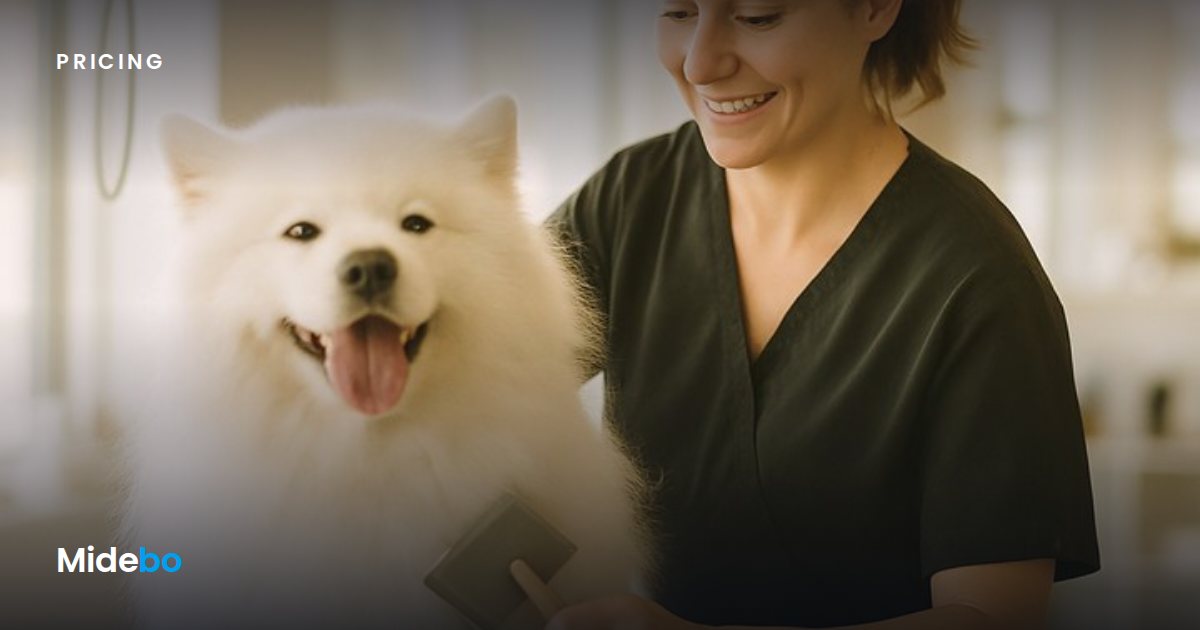
Grooming has a pricing problem that most trades do not: you cannot see the job before you book it, and two jobs with the same name can differ by ninety minutes.
A well maintained doodle on an eight week schedule and a doodle that has not been brushed since spring are the same booking on your calendar and completely different days for you. One is a groom. The other is a dematting job with a groom at the end, and it will run over, push your afternoon back, and hurt.
Here is how to price for that without turning every phone call into an interrogation.
Breed is a starting point, not a price
Most price lists start with breed, and breed is genuinely useful shorthand. It tells you roughly the size, roughly the coat type, and roughly the standard cut.
What it does not tell you is the three things that actually decide how long you are standing there:
Coat condition. The single biggest variable. Matting turns an hour into three, and it is the difference between working and fighting.
Temperament. A dog that will not stand still, will not let you near the feet, or needs two people is a different job at the same weight and coat.
Time since the last groom. Everything is worse at sixteen weeks than at eight, and the customers who come least often are the ones who will tell you their dog is easy.
So price the breed, then adjust for those three. The menu price is where the conversation starts.
The questions that get you close on the phone
You are trying to find out about coat, behavior and history without making the caller feel judged. Four questions do most of it:
- "When was the last groom?" The most informative question you can ask, and it sounds like scheduling rather than pricing.
- "How is the brushing going between grooms?" Note the wording. Not "do you brush him." People answer this one honestly because it is not an accusation.
- "How does he do with the dryer and with having his feet done?" These two predict a difficult groom better than anything else.
- "What are we doing with the coat this time?" A shave down and a full scissor finish on the same dog are wildly different amounts of work.
From those four answers you can give a range with confidence, and you have also learned what to prepare for.
Quote a range and name the condition
Same principle that works everywhere else, and it matters more here because the uncertainty is genuinely larger.
"For a doodle that size we're usually eighty-five to a hundred and ten. If the coat's in good shape it's the lower end. If we find matting that has to come out, that adds time and I'd be at the top or a bit above, and I'll call you before I go ahead rather than surprise you at pickup."
The last clause is the one that prevents the bad conversation later. You are not promising a price, you are promising no surprises, and that is what the customer actually wants.
Charge for dematting, and charge properly
A lot of groomers absorb dematting because it feels awkward to charge for it. It is the most physically demanding work you do, it is slow, it is hard on the dog and hard on your hands, and absorbing it means your careful customers subsidize the neglectful ones.
Charge for it by time, in blocks. Fifteen minute increments are easier to explain and easier to defend than a vague surcharge.
Say it at booking, not at pickup:
"If the coat is matted enough that it has to come out rather than brush out, I charge in fifteen minute blocks for that, and I'll call you first so you can decide between the dematting and a shorter cut."
That sentence does three things. It sets the expectation before anyone is standing at the counter. It gives the customer a real choice, which most of them appreciate. And it makes clear the humane option is on the table, which matters because the right answer for a badly matted dog is usually the shorter cut.
The surcharges worth having, and the one that is not
Worth having: matting by time. Behavioral handling, where the dog needs two people or significantly more time. Size beyond your standard bands. Same-day and peak weekend slots if you are consistently full. A flea bath, because it costs you product and a full cleandown.
Not worth having: a surcharge that punishes someone for something they cannot control, applied without warning. Senior dogs need more time and more care, and they are also the customers most likely to be with you for years. Build that into the price rather than adding it at the counter.
The test is simple. If you would not be comfortable saying it on the phone at booking, do not add it at pickup.
Build the schedule around the long ones
The other half of pricing is scheduling, because in grooming they are the same problem. One job that runs two hours over does not cost you two hours. It costs you the rest of the day.
Put the unknowns early. A new client, a first groom, or a dog you have been warned about goes in the morning, when running over eats into slack rather than into the last appointment. Regulars on a known schedule are safe in the afternoon.
Leave a real gap somewhere in the middle. Not a gap you will fill if someone calls, a gap that is there so the day can absorb a surprise. It will feel like lost revenue and it will save you more bookings than it costs.
Rebook before they leave
The single best thing for both your pricing and your schedule is a customer on a regular cycle. A dog groomed every eight weeks stays easy, which means the job stays the length you priced it at, which means your day runs on time.
Book the next appointment while they are standing there. Say why: "If we keep him on eight weeks the coat stays easy and it stays this price. Leave it to sixteen and we're into dematting."
That is not a sales line. It is the actual mechanism, and customers respond to it because it is obviously true.
What happens to the calls you miss
Grooming is an appointment business, which means every booking arrives as a conversation. There is no version of this where somebody books without reaching you first.
And you are working with both hands on a dog for most of the day, which is exactly when the phone rings. A missed grooming call is rarely someone who calls back later. They call the next salon, and if that salon books them, you did not lose a groom. You lost every groom that dog would have had for the next several years.
That is the real number, and it is why the phone matters more in this trade than in almost any other (here is how to work out what your missed calls cost).