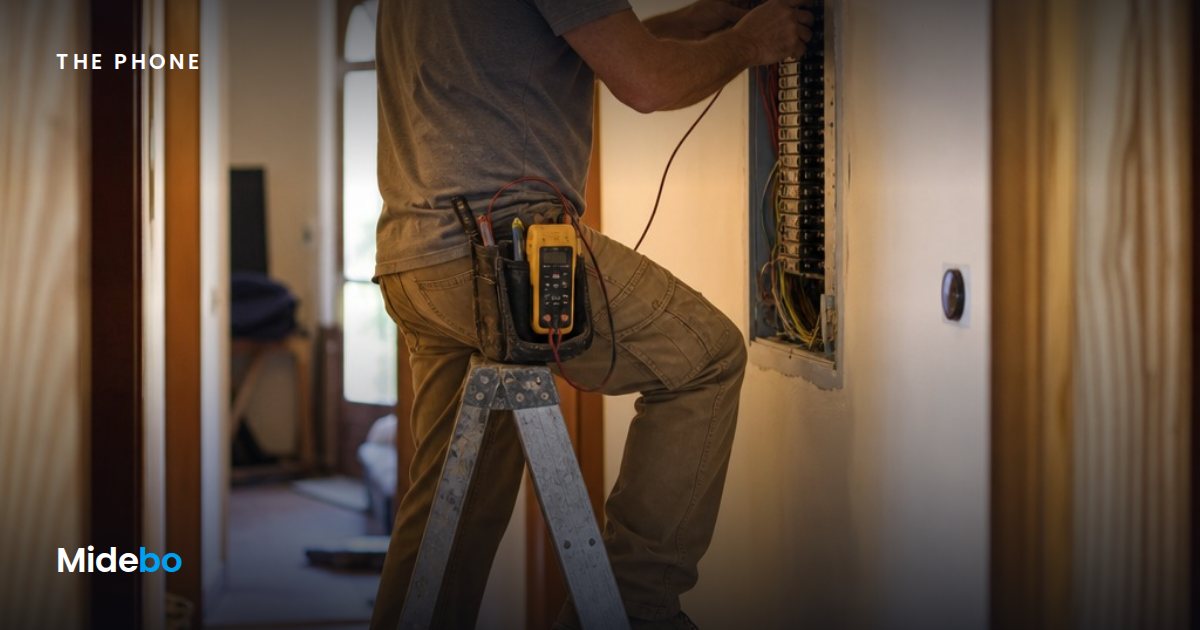
Two calls come in twenty minutes apart. Both callers open with the same four words: "I lost my power."
One is a tripped GFCI behind a bathroom vanity. The other is a scorched neutral in a 1950s panel in a Webster Groves ranch. On the phone they sound identical. What separates them is not instinct. It is the order you ask your questions in.
The words that move a call to the front of the line
Most electricians in the St. Louis area end up with a short list of things that get a truck rolling tonight. The exact list is yours to set, but the language callers use is pretty consistent.
Burning. Callers say it a lot of ways: a fishy smell, a hot plastic smell, an smell like something electrical. A smell with no visible source is different from a smell coming out of one receptacle.
Hot or discolored. A cover plate too warm to keep a hand on, a brown ring around a plug, a breaker that will not reset and is warm at the handle.
Sound. Buzzing, humming, crackling at the panel or the meter base. Callers usually describe it as frying bacon.
Water. A basement that took on water with the panel low on the wall, a roof leak that found a junction box, a slab leak near a subpanel.
Mechanical damage. After a straight-line wind night, the call is a mast pulled away from the house, a service drop laying on the driveway, or a tree on the line. Those come in bunches and every one of them opens the same way.
Everything else is a service call, and service calls can be scheduled without anybody losing their evening.
Five questions, same words, every time
The point of a written script is not that you cannot think on your feet. It is that the answers become comparable. Ten notes that say "power out" tell you nothing. Ten notes that answer the same five questions let you sort the list in two minutes.
- Is anything burning, smoking, sparking, or hot to the touch right now?
- Is there water anywhere near it?
- Is it the whole house, part of the house, or one outlet or fixture?
- Do the neighbors have power?
- Where is it, what kind of building, and who is going to be there to let a tech in?
Question three is the one that earns its keep. Half the house dark, or lights that go dim and bright when the dryer runs, points somewhere very different than one dead bedroom circuit. A caller who says "the microwave clock is flickering and the fridge sounds funny" has told you something without knowing it.
Question four sorts your work from the utility's work. If the whole block is out, that is an Ameren call and the customer can check the outage map before anybody drives anywhere. If the house next door has lights and this one does not, the problem is on this property. Where the ownership line falls between the utility's equipment and the customer's mast, meter base and panel depends on your local rules and the utility's own definitions, so that part is worth confirming with them rather than guessing on the phone.
Commercial calls need a sixth question
A dead outlet in a spare bedroom is Tuesday. A restaurant on Manchester with a walk-in cooler down is losing product by the hour, and the manager will pay after-hours rates without blinking. A tenant finish-out with no power to half the receptacles is an emergency for the general contractor and nobody else.
So for anything commercial, add: what is not working, and what does that stop you from doing? The answer tells you whether this is a tonight call or a first-thing-tomorrow call, and it tells you what to bring.
This is not unique to electrical work. A plumber sorts water actively running from a slow drip the same way. A garage door tech separates a door stuck open overnight from squeaky rollers. An auto shop separates a car dead in a parking lot from a check engine light that has been on for a week. Pool service separates a green pool before a party from a weeping pump seal. Same logic, different vocabulary.
Set the after-hours number before the phone rings
Whoever answers should be able to say your after-hours rate and diagnostic fee out loud without putting anybody on hold. If that number lives only in your head, every evening call turns into a callback, and callbacks are where jobs leak out.
Decide it once. Write it on the same card as the five questions.
Covering the calls you physically cannot take
You cannot answer a phone with both hands in a panel, and you should not try. That is the whole problem. The calls that need triage most are the ones that arrive while you are already working.
The usual options all have a cost. Voicemail is free and the caller dials the next electrician in the search results. A spouse or office person works until they are at the grocery store. Forwarding to whichever tech is not on a ladder means the least experienced person is taking the emergency call. Answering services will take a message, but a generic message taker will not ask question three or question four, and those are the two that decide whether you drive.
Whatever you use, judge it on one thing: does it come back to you with the five answers, or just with a name and a number?
What to do tonight
Write the five questions on an index card. Tape one to the dash of the van and put one wherever the office phone lives.
Then pull up your call log from last week. For every after-hours call, mark whether it actually needed a truck that night. If most of them did not, you are burning evenings for nothing. If most of them did and you missed some, you already know what that costs, and you can work out roughly how much by taking your average service invoice and multiplying it by the share of quoted jobs you normally close.
Start with the card. The rest gets easier once every call comes back in the same shape.